Canada’s meeting place for freelance writers and creators
Established 2010
Canada’s meeting place for freelance writers and creators
Established 2010


 Read your contracts.
That was the overarching message from the opening session at the recent Level Up conference in Toronto.
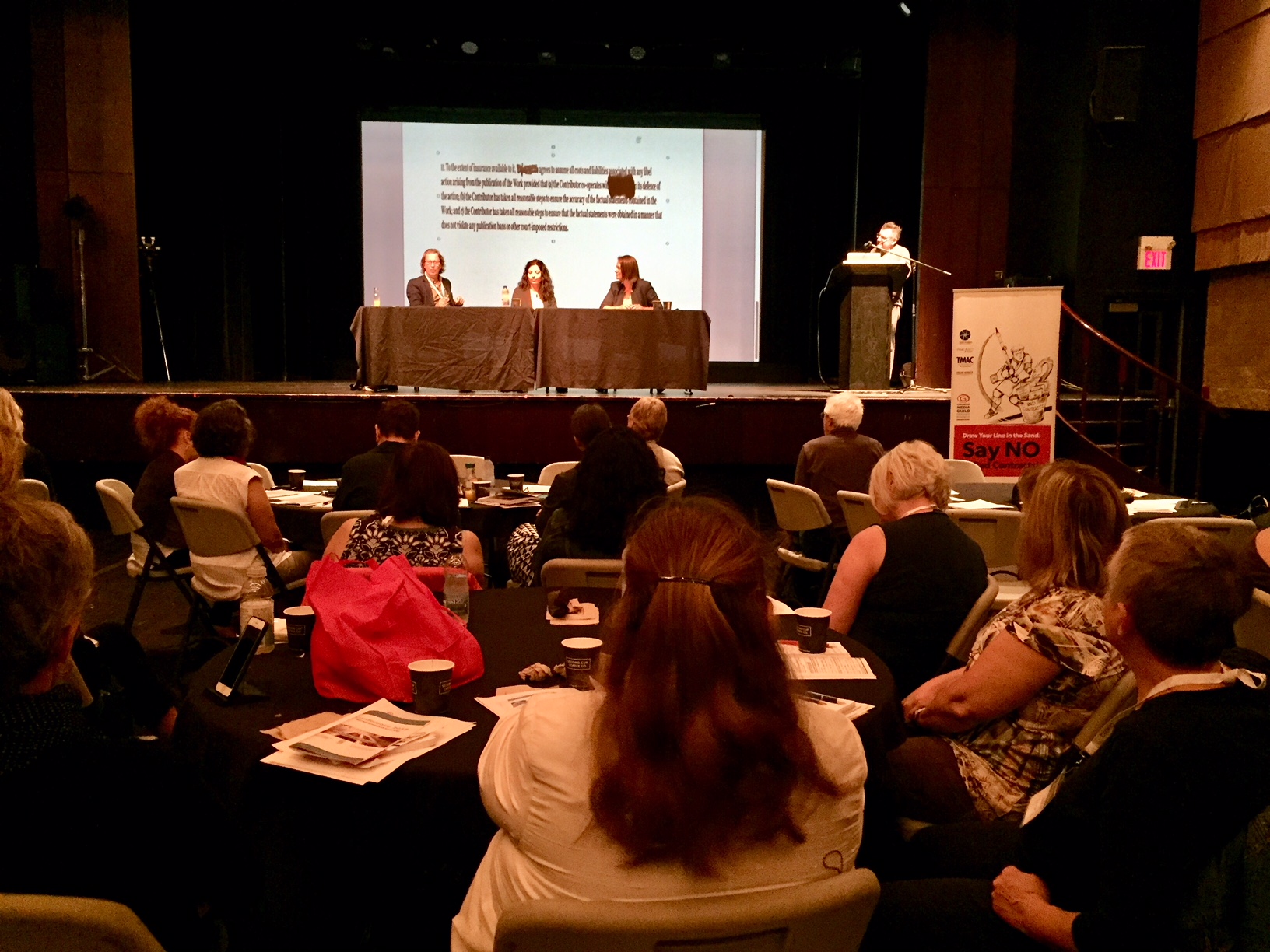
The session, called "Contracts: The Good, The Bad and The Ugly," featured lawyer Tassia Poynter, Content Writers Group founder Derek Finkle and freelance science journalist Alison Motluk. CMG Freelance president Don Genova moderated the discussion, which was co-presented by the Professional Writers Association of Canada and CMG Freelance on September 21 at the Miles Nadal Jewish Community Centre.
In her opening remarks, Poynter said it’s surprising that some contracts can be as long as ten pages but fail to include information that freelancers need to know. That information, she said, includes details about money – what you’re getting paid and when. A contract should also include details about when you need to complete the work you’ve been hired to do. Copyright is another word to look out for, said Poynter. Who will hold the copyright and for how long? Will you have the right to resell your work at a later date?
But it was the subject of indemnity clauses that dominated the discussion. Language about liability, said Poynter, is often lengthy and impenetrable. Some contracts spell out what will happen to the publisher in case of a lawsuit, but don't cover what would happen to the writer. Finkle noted that the class action lawsuit launched by freelance writer Heather Robertson in 1996 led to an increasing use of freelance contracts by publishers. The lawsuit, filed against the Globe and Mail and other publishers, claimed that freelancers should be compensated when their articles are used in a publication’s digital archives. The case went to the Supreme Court in 2005 and resulted in a multi-million dollar settlement.
Over the course of the 2000s, Finkle said, contracts grew more demanding as publishers sought to claim the rights to publish writers’ work online without further compensation.
Motluk has often made changes to her contracts – scratching out indemnity clauses, for example – but there have been times when publishers have refused to accept her changes. In fact, she said, she had requested changes to two different contracts during the past week but had been turned down both times.
Although she finds it frustrating to pass up lucrative assignments because of indemnity clauses, she doesn’t believe such contracts are worth the risks they pose to her assets. Since libel lawsuits can arise over unexpected issues, she said, it’s impossible to predict what might lead to trouble.
“Some people are going to be mad and they’re going to sue. Some people are going to be mad and they’re not going to sue,” she said.
Motluk agreed.
“The writer and the magazine should be working together,” she said. “It’s not that I’m saying I don’t want to take responsibility for my work, but the magazine goes through a fact checking process as well. I willingly go through that process, provide any material they ask for. And then if a lawyer looks at an article and suggests a change, I agree with that lawyer. But after going through that whole process, and then agreeing to help them if trouble arises… well I don’t know why they’re not going to agree to help me if someone decides they’re going to sue.”
Genova asked Poynter whether it’s a problem for publishers to cover freelance writers under their own insurance policies. Poynter said it depends on the terms of the insurance. But she also said she thinks in most cases such coverage would not be an issue.
Although editors or publishers may advise freelancers not to worry -- that they’ll protect them in the case of a lawsuit -- Poynter said these kinds of conversations and assurances are unlikely to help in the event that trouble arises.
“Your side conversation is not going to get you anywhere,” she said. “You need to ask them to change the contract. That’s going to be what governs the situation if things go sideways and you end up in legal trouble because of an article.”
It can be very uncomfortable trying to negotiate contracts, said Poynter. And there is a much more hardline attitude from publishers emerging. If the publisher you’re working with is not willing to agree to reasonable limits, she said, you’ll have to decide whether you’re willing to work with them.
Speaking from the audience, author and freelance writer Ann Douglas said she thinks the situation has grown dire and that freelancers need to take a stand against unfair contracts.
“We’re at the point where our career is about to become completely unsustainable," she said. “So if you can’t do this for yourself, do it for the next generation.”