
Canada’s meeting place for freelance writers and creators
Established 2010
Canada’s meeting place for freelance writers and creators
Established 2010


by Don Genova 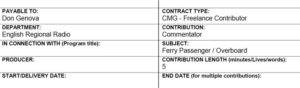
There are actually A’s, and B’s, and C stands for Copyright in a typical CBC Freelance Contributor Contract, but I’ll get to those in a bit.
With the new broadcast season, more local and national programs, radio, TV or digital, will be engaging freelancers to provide material for their shows in the form of interviews (some with recordings, some not), documentaries, columns, photographs, and research or writing, especially for digital purposes.
Quite often I’ve found both freelancers and the people commissioning them don’t understand the contracting process, and inevitably this results in confusion, and unfortunately the confusion often leads to the freelancer getting paid less than the minimum amounts guaranteed in the CBC-Canadian Media Guild collective agreement.
If CBC wants you to do something for them, don’t be afraid to ask for a contract up front that specifies exactly what it is you’re going to do and what the pay rate is. If a contract isn’t forthcoming, make sure you get it in an email.
Freelancers (not temps or casuals) can only be offered two kinds of contracts. The Freelance Specific Services contract can be quite complex. I’ll deal with that one soon. The one that is much more specific about what you do and what you get paid is the Freelance Contributor contract. You get contracted by a particular category, and the categories cover audio, audio-visual, text, and photos.
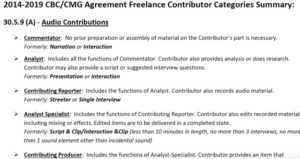
The more complex the work you’re asked to do, the more you get paid. So being interviewed or de-briefed by Matt Galloway on Metro Morning in Toronto for example, for up to 15 minutes as a Commentator will pay you $155.61 (less CMG dues of 1.55%).
But say you were in there every week chatting with Matt and you were bringing your own ideas to the table and writing your own scripts. Then you’re an Analyst. For just 3 minutes on air you would make a minimum of $153.98, plus $11.53 per minute for every minute or portion thereof that the interview lasted. So your column goes for 7 minutes, say? Then you’re up to $200. The category acknowledges you’re bringing more to the table because you’re doing the writing.
If you’ve gone out and interviewed some people, and have cut some clips and inserted them into your chat with Matt, then you are a Contributing Reporter or an Analyst-Specialist and the minimum rates rise even higher. It’s a documentary, you say? Then you’re a Contributing Producer. $Ka-ching!
I got the numbers above from the most current pay scales negotiated on your behalf by CMG. We have a neat little Excel file showing all the categories and the minimums for each category here on our CMG Freelance website.
The categories themselves are printed on the back of every contract you are asked to sign, or you can view them in advance starting on page 96 of the collective agreement.
There may be some discussion between the freelancer and the commissioning producer about the exact category to use, or confusion over the rules that dictate when a contributing reporter contribution suddenly becomes a contributing producer contribution.
It’s important to iron out the distinction ahead of time. For example, a ‘tape and talk’ Contributing Reporter contract can become a Contributing Producer contract if it crosses certain parameters such as length, or sound elements, or number of people interviewed. On a lengthier piece, this distinction could mean a difference between being paid $800 and $2400, so it’s really important to get it right.
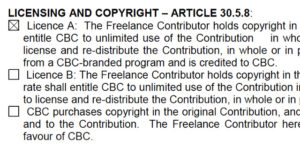
In License A, the freelancer retains copyright in the piece, although CBC gets the right to use and reuse your contribution on any CBC platform.
In License B, the freelancer also retains copyright, but the CBC, in addition to the reuse rights, can also sell the item to a third party. For that right, the CBC must pay at least a 10% premium on the original value of the contract. Notice I said at least. Any time a figure is mentioned in the freelance part of the agreement, it is a minimum and can be negotiated higher, but never lower.
The last box is for Copyright. If this box is checked, CBC owns the piece you submit lock, stock, and barrel. But it must negotiate the rate. Since you are giving up copyright, you might want to ask for a lot more than the minimum.
Normally License A is checked by default in the contracting system, but make sure you double-check when you get your copy to sign.
These different categories, rates, and licenses can get confusing, I know. But that’s why CMG Freelance is here to help. Don’t hesitate to get in touch with me if you have any questions about these contracts and categories. Normally I can answer you within a few hours or by the next day. Drop me a line at freelance@cmg.ca.
Soon I’ll have some advice on dealing with the Freelance Specific Services contract, quite a different beast from Freelance Contributor.
Don Genova is the president of CMG Freelance. He’s a longtime freelancer with 20 years of experience contributing to the CBC, magazines and newspapers.