Canada’s meeting place for freelance writers and creators
Established 2010
Canada’s meeting place for freelance writers and creators
Established 2010


[caption id="attachment_1105" align="aligncenter" width="580" caption="A screen capture of Benetton's article, published by Lawyers Weekly."]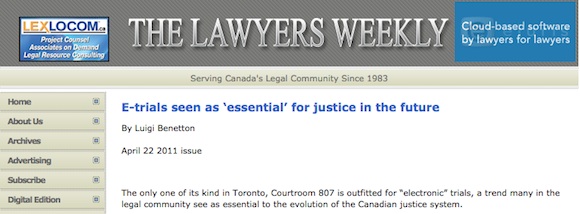 [/caption]
Imitation may be the sincerest form of flattery, but not when your work isn't credited — or compensated. Earlier this month, freelance writer Luigi Benetton received a message from an editor who had come across one of his articles online. The only problem was that it was posted under someone else's byline and it was on a site he's never heard of, let alone heard from. The post matched, word for word and even the headline, an article Benetton had written for The Lawyers Weekly, a publication owned by LexisNexis.
The article was published on a site called eBizDocs.com, a site based out of Menands, New York, that calls itself "an award-winning electronic document management service provider that is committed to helping companies, state agencies, local governments and other organizations find electronic solutions to otherwise inefficient record management systems." It was attributed to "Benedict Dabrowski," who appears to be an employee of the company and quite possibly a real person. His byline appears on various articles on the site, including press releases about the company's charitable initiatives.
Benetton notified the managing editor of The Lawyers Weekly, Tim Wilbur , who sought advice from in-house counsel at LexisNexis. Based on that advice, Wilbur wrote an email to the eBizDocs, demanding they take action, and threatening to get lawyers involved, if they didn't. [Note to prospective plagiarizers: don't steal work from an publication that has "lawyers" in its title and not expect to hear from some.] Less than an hour later, the article was gone from the site. Google's caching function still picks it up, though (see screen capture).
[caption id="attachment_1115" align="aligncenter" width="580" caption="A screen capture of a cached version of the story originally published April 25 on eBizDocs.com. "]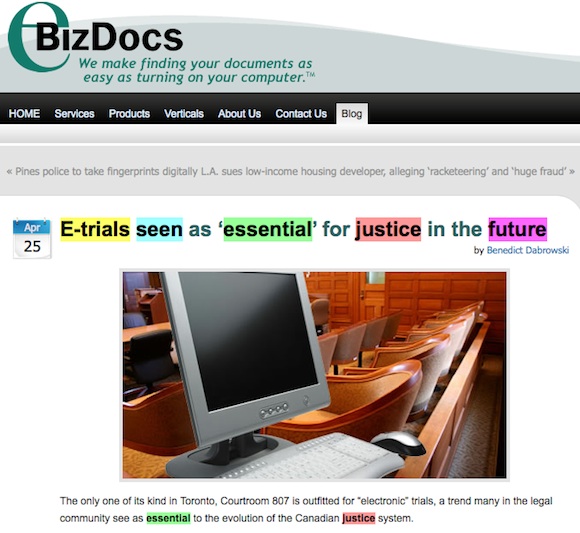 [/caption]
Benetton says no one from eBizDocs contacted to explain what happened or to offer an apology. Despite the fact that his work was posted on the site for weeks, without his knowledge or permission, he did not plan on seeking compensation from the site and said he wouldn't know how to go about it.
Are there really no consequences for plagiarizing other people's work online?
We asked Wilbur, a lawyer himself, whether there would be any point in suing the eBizDocs site for damages, since it seems there's a strong case to prove the site knowingly plagiarized Benetton's work. Would the potential rewards not be worth the time and money required to undertake legal action? His response, simply: "No." He says that, in this case, there is no point in taking legal action, as the damages would be far smaller than the cost of pursuing this course of action."
We contacted Benedict Dabrowski by email to ask how his byline ended up on the story. He did not respond.
Has your work been plagiarized? How was the situation resolved? Do you know, or know of, anyone who has sued for damages and won? Please share your experiences in the comments below.