Canada’s meeting place for freelance writers and creators
Established 2010
Canada’s meeting place for freelance writers and creators
Established 2010


In this regular feature, Story Board asks Canadian writers to share a few details about their work habits and their strategies for navigating the ups and downs of freelance life.

Caitlin Kelly is a Canadian writer based in New York City. She has been writing for clients such as The New York Times, Smithsonian, More, and Marie Claire for over 20 years. She is a prolific blogger with more than 15,000 blog followers worldwide. She also works as a writing teacher and a private writing coach. Caitlin took the time to speak with Story Board recently about writing rates, building your online presence and the importance of having a posse. The conversation was fascinating and wide-ranging. Here are some highlights:
And the blog is a really wonderful place to just write. The reality of freelancing is that we make-to-order. We do intellectual piecework. The blog gives me a place to explore, to noodle things over. I get a global conversation. I just want to talk to smart people around the world. And my blog followers are those people.
To me a blog is an artist’s proof. It's a place to test out an idea, a different language, a different approach. It's my little magazine. I think it's great practice. You write your hed, you write your dek, you write your captions. I think it really keeps you sharp in thinking how an editor thinks.
So the blog helps me remember to a) be creative, play and b) think visually and c) try stuff out, see what your readers think of it.
Hence #MissingAZero. If you're making $150 a story, how can you make a living? You'd have to write about 20 pieces a week. I don't know how you're going to do that, but let's say you do. Can you sustain that pace? And then the next question, which, to me, is really important, is do you want to? And the next question is "what's the quality of the work you're producing?" And the question after that is "And what it is leading to?" Because at that point you're a hamster on a wheel. You're not producing work that's going to get the agent to sell the book that's going to help make your reputation.
I think there's a lot of discomfort if you’re working as a waitress or barista or whatever. "What if my editor sees me? What if a friend sees me? What if my journalism professor sees me?" You know what? Give them a big smile and ask them to leave a tip. Do what you've got to do to get the bills paid. Because at the end of the day, you want to produce good work.
I just read a review of a biography of T.S. Eliot, apparently the guy worked at a bank. There was a beautiful photograph of T.S. Eliot, who was a legendary writer, in his banking clothes. People forget this.
There's this bizarre notion, like we should all be able to support ourselves on being an artist. Well some of the best writers in the whole world never did that. They had patrons. There's no Medici paying my mortgage. We don't have that sort of model. Very few of us win the fellowships, win the grants. It's really, really hard. So do what you have to do to get the money in.
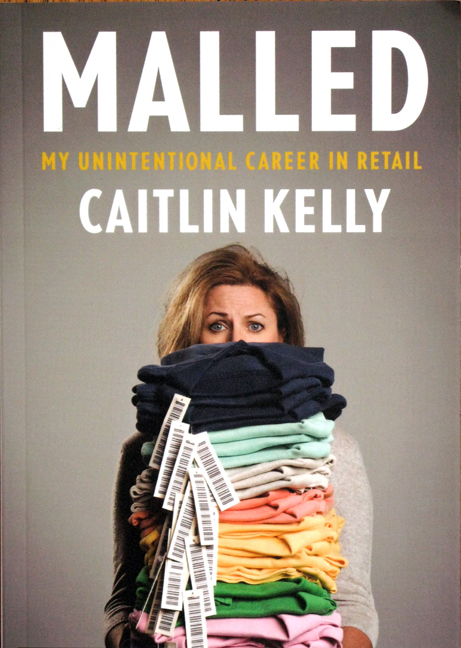
My job working retail, I folded t-shirts, I swept the floor, it was a tough job. Two and a half years I did that job for The North Face. It was the best thing I ever did because I would come home and I would say to myself "you just sold a $600 ski jacket to a hedge fund guy from Greenwich. Why can't you sell a story to fill-in-the-blank?" Now I know how to close a sale. Your writing is just another product. Go sell your product.
You can be passionate about your work and still say "can you pay me more?" And this is a conceptual leap people have to make. You have to say "can you do better" or "I've done three pieces at this rate, can we bump up the rate?" And I think it's very legitimate if you live in Vancouver or Toronto, the two worst. If somebody is going to be really cheap with you, you may just recuse yourself and say, really nicely, "we're probably not a good fit for each other."
Stuff takes time. You have to say "do I really want it?" "what's it worth to me?" "what sacrifices am I willing to make?" There are going to be sacrifices. There were years all I could do was pay bills. There are years that just aren't a lot of fun. But those are years that you're building your portfolio, you're building your contacts, you're spending money going to conferences. You're taking some classes. Whatever it is that's going to build your skill set so that suddenly you're not the 20th person competing for a $50 story. Just get out of that pool.
I think you have to be very clear "who do I want to write for," or "where do I want to be published." "How do I meet those people? Where are they?"
You have to be a nice person. You have to be a fun, interesting, alive person who reads, who travels, who looks you in the eye, who shakes your hand, who writes a thank you note (maybe on paper!), who picks up the phone. That's part of the piece right now. Our industry's really hard. We're going through a really challenging time. There are a lot of places to write, this is not a dead industry. But you have got to jump around.
Two words I want to give younger writers: be flexible. Not "work free," "be flexible."
People will really play rough with younger writers. The people you're dealing with are businesspeople. And guess what businesses need to do: they need to make a profit. And guess where they're going to make a profit: off of your labour.
Caitlin Kelly has won the National Magazine Award for her writing. Check out her blog for information about two upcoming writing workshops that she's teaching in Tarrytown, NY. You can find links to her work on her website and follow her on Twitter at @CaitlinKellyNYC.