
Canada’s meeting place for freelance writers and creators

Established 2010

By Cara Fox

[caption id="attachment_15645" align="alignright" width="248"] (Twitter photo courtesy of @msangelamc)[/caption]
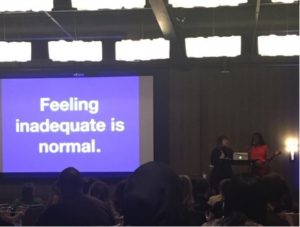
If I’m honest, for many years the only thing that kept me from freelancing was the fact that I didn’t feel good enough. No matter how many qualified people told me I was capable, complimented my work and prodded me to keep going, it wasn’t enough to make me feel “credible.”

What I didn’t realize then was that feeling would never fully go away, even after j-school and a handful of successful gigs. In fact, there’s a name for it. It’s called imposter syndrome; the persistent inability to believe that your success is deserved and is a result of your effort or skills.

Last weekend, Katie Jensen and Vicky Mochama spoke about imposter syndrome at the annual Canadian University Press conference, NASH81: Refine.

Founders of Vocal Fry Studios, a Toronto-based podcasting hub that produces media created by under-represented groups, Jensen and Mochama delivered a powerful message to emerging journalists on how to overcome imposter syndrome and forge a rewarding career path in new media.

The Media Doesn’t Reflect Us

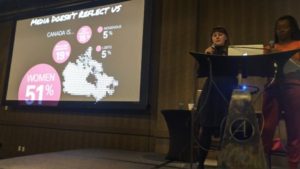
“Journalism is like any other industry,” announced Mochama, addressing the gala hall full of eager student journalists at the Hotel Arts in Calgary, AB. “It's moving forward without being aware of how it's holding people back." Powerpoint slides to her right displayed statistics of under-represented groups; Canada’s population is made up of 51 per cent women, 19 per cent racialized minorities, 15 per cent people with disabilities, five per cent Indigenous peoples and five per cent LGBTQA+ persons.

With a total of 95 per cent of Canada’s population represented in one or more of these groups, one might expect a more diverse representation in Canada’s media landscape.

But 70 per cent of Canadian media is owned by four major companies (Bell, Rogers, Telus and Shaw) and it has been said journalism in this country risks narrative homogenization alongside shrinking media ownership. The result of media “tunnel vision” can mean stories that fall outside the margins are left untold.

[caption id="attachment_15650" align="alignleft" width="300"] (Twitter photo courtesy of @ts_lambert)[/caption]
But according to Jensen and Mochama, the often all-too-narrow focus of media doesn’t just stunt story coverage. It also directly affects journalists who seek to establish careers in the field.

Systemic barriers and discrimination rob workers of opportunities or push them into precarious and harmful conditions for the sake of a paycheque. Many experience feelings of failure or self-doubt, but not because they are bad at their jobs. It’s because their contributions are undervalued or dismissed by their employers.

“We feel imposter syndrome because the systems that are set up around us are designed to be unwelcoming,” explained Jensen. It is the systems themselves that can convince us we don’t belong, they explained, often in the very places it tells us we need to be to succeed.

Advice for overcoming imposter syndrome

The good news is that this isn’t actually the case, they said. Now, more than ever before, there is a demand for unique stories to rise up from the margins.

There is opportunity, said Mochama and Jensen, in challenging the status quo. While it isn’t easy, they shared some candid pieces of advice for those who wish to overcome imposter syndrome and forge their own path inside or outside mainstream media:

  • Do not doubt yourself or your story. There will be other people that do that for you, don’t be one of them.
  • You have a voice, do not be afraid to use it. Believe in and defend your ideas.
  • Connect and surround yourself with other professionals who will support you. Elevate the field by supporting them too. You never know, they may just become the people you go into business with someday.
  • Do not be afraid to burn bridges. Stand up for the things you truly believe in, and if someone disagrees with you, do not be afraid to light a match and walk away. If it costs you a job, it is most likely not a job that you want to be associated with anyway.
Mochama and Jensen consider themselves living proof that overcoming imposter syndrome by standing up to challenge the status quo is not only possible, it pays long-term dividends.

Less than two years into their podcasting project, which began as PWYC workshops at a coworking space in Toronto, Vocal Fry Studios is now a full-time studio that Jensen and Mochama run full-time.

Charting their own course was a risk, they said, but it was worth it for the freedom and satisfaction they now enjoy.


Cara Fox is a freelance multimedia journalist based in Montreal, Quebec. She has written for CBC, the Suburban, exclaim! magazine and is currently seeking opportunities in digital multi-platform media. You can find her at @foxcara or www.carafox.ca
 

Once a week, we gather stories about the media business, journalism, writing, communications, and freelancing—with a Canadian focus—and share them in Off the Wire. Who needs a water cooler?From Canada: CBC Non-fiction prize open for entries [CBC Books] 2018 CAJ Awards call for entries [CAJ] Call for entries: 2019 Digital Publishing Awards…
By Christine Peets[caption id="attachment_15629" align="alignright" width="225"] Toronto-based writer Paul Lima[/caption]If you choose to make New Year’s resolutions, you might notice the same themes arising year after year. They often involve trying to be healthier by getting more exercise, eating healthy food, balancing the work/life stuff,…
In this regular feature, Story Board asks Canadian freelancers to share a few details about their work habits and their strategies for navigating the ups and downs of freelance life. Angela Mombourquette is a Halifax-based freelance journalist who has written for such publications as The Walrus, Halifax Magazine, and the Chronicle Herald. She…
Once a week, we gather stories about the media business, journalism, writing, communications, and freelancing—with a Canadian focus—and share them in Off the Wire. Who needs a water cooler?From Canada: National Magazine Awards call for entries [Magazine Awards] Changing public perceptions of mental illness [J-Source] Skill-sharing workshops…
This series of posts by the Born Freelancer shares personal experiences and thoughts on issues relevant to freelancers. Have something to add to the conversation? We’d love to hear from you in the comments. OK, so nobody will ever accuse me of being an impulse-shopper.I've been looking into buying an up to date portable digital recorder…
If you've written a great piece of magazine journalism this year, the time has come to make a submission to the National Magazine Awards. If your publisher isn't planning to submit your work, you can submit it yourself -- and the awards foundation even offers freelancers a discount on entry fees.The Freelancer Support Fund offers a 50 percent…
Once a week, we gather stories about the media business, journalism, writing, communications, and freelancing—with a Canadian focus—and share them in Off the Wire. Who needs a water cooler?From Canada: The case for indie news media taking federal dollars [The Tyee] Alberta Press Council to shut its doors [Alberta Press Council] The 2018 CAJ…
By Nkiru AsikaThis isn’t an article about whether you should choose a niche.[caption id="attachment_15570" align="alignright" width="200"] Heather Greenwood Davis[/caption]I believe that specialization is key to stand out from the writer-saturated landscape. Jack of all trades and all that.If your writing business is still new like mine, (I…
In November members of the CMG freelance bargaining subcommittee met with CBC management to begin negotiations on provisions for freelancers in the CMG-CBC collective agreement, which expires March 31, 2019.  The major issues under discussion are  - the proper use of contracts including:        - the appropriate use of the different…

Page 36 of 160

First 34 35 36 37 38 Last