
Canada’s meeting place for freelance writers and creators
Established 2010
Canada’s meeting place for freelance writers and creators
Established 2010


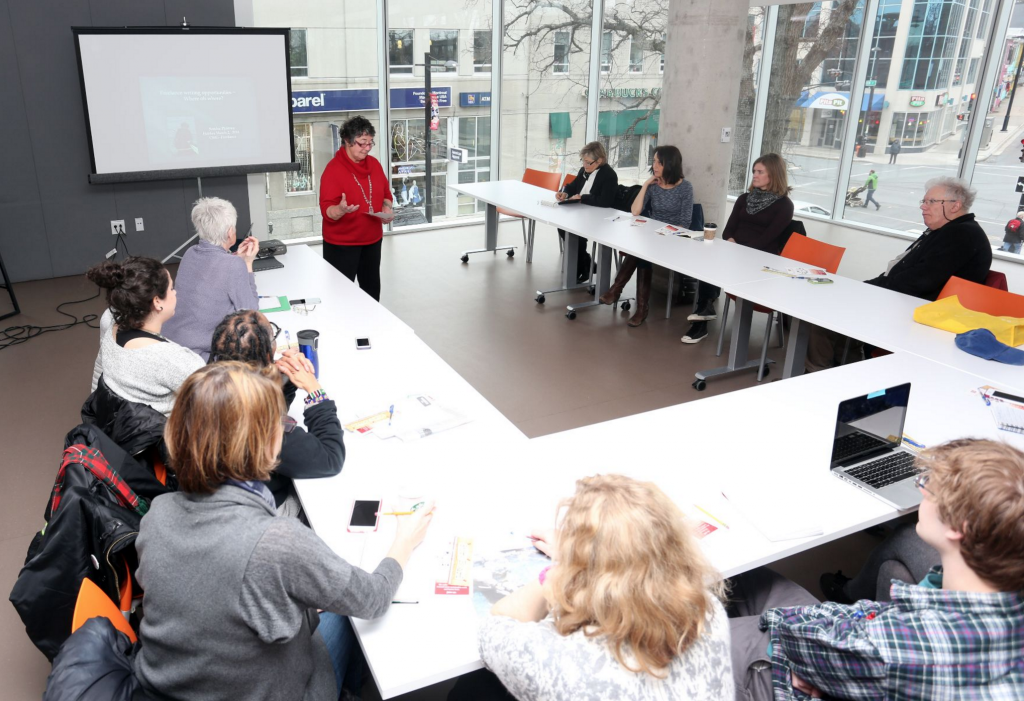 Sandra Phinney speaks at the Selling Your Stories workshop[/caption]
By Rebecca Hussman
CMG Freelance and CWA Canada hosted an event for media workers at The Company House in Halifax last week, focusing on workers’ rights and making it in the industry as a freelancer.
The event began with a brief presentation on building a sustainable career in the media by CMG organizer Buffy Childerhose and Katherine Lapointe of CWA Canada.
The presentation started with a tip that's especially relevant for media workers in the province right now, with the ongoing strike at the Chronicle Herald: value your work and worth.
“The [striking workers] will only be able to negotiate a fair contract with support from the entire media community. And in turn, freelancers and students will stand to benefit from a contract at the Herald that sets fair rates of pay and protects good jobs for the next generation,” Lapointe said.
“The more we can work together the better for us all.”
Childerhose says the most important thing a freelance media worker should remember is: always get it in writing. If no contract is provided, freelancers should at least lay out the terms previously agreed upon in an email to protect themselves. This ensures that there is a copy of the agreement in writing should any issues or disputes arise. “The big danger sign is when somebody says, ‘Just sign this and send it back to me,’ because it reveals to you that they don’t understand the nature of what a contract is,” Childerhose said, adding that, fundamentally, a contract should be a negotiation between two parties.
“It should not always just protect the engager, it should protect you as well.”
Another important thing to look out for in a freelance contract has to do with credit -- what’s known as moral rights. Both Lapointe and Childerhose were adamant in advising workers to beware of contracts asking you to surrender your moral rights. By giving away your moral rights, you essentially give your engager the ability to remove your byline from your work as well as giving them the ability to alter the content of your piece in any way they want.
“Think hard before signing a contract that asks for your rights, or at least make sure that you’re getting really good pay out of it,” said Lapointe.
Sometimes, freelance workers may find themselves accepting a job for a rate that is less than desirable. But Childerhose says if your byline is on it, it may be worth it.
“The credit is the thing that’s going to get you your next job, so it’s really really important. Don’t give that away,” advised Childerhose.
The next thing to be mindful of as a freelancer has to do with the scope of the project. Both presenters advised agreeing on scope before beginning any project.
“This is one of those things that anybody who is doing any kind of freelance work now, sadly, is aware of: that people just kind of keep piling things on. You may be happy to do it, but you should be compensated for it,” Childerhose said.
Some other advice that came up during the presentation was:
“Freelancing can be a lonely life, so meeting people with like interests is important for networking," Genova said.
"Our workshops are designed to give our members and potential members some tools to help them develop their freelance careers."
In the first half of the workshop, Phinney gave tips for submitting queries and finding work in the magazine sector. Before submitting a pitch, Phinney advises researching the outlet thoroughly by reading the publication’s advertisements to gain insight into their reader demographic. Also, take note of how stories are written in terms of approach, tone, voice, style and structure.
This allows you to refine your queries to fit in with the rest of the outlet’s content and align with their core values.
Phinney says the best strategy for earning as much as possible for your work is to follow the ‘Three R’s’ of freelance writing: Reuse, Repurpose, Resell."
"The trick is to re-craft one story into as many as possible," she says, "so that the story just keeps on giving.”
“I aim for three if I’m doing a major piece,” she says. “I try to find three different ways of spinning a story and three different markets to sell it to.”
Phinney also discussed the importance of finding the right partners to form a team with, and different strategies for getting your name out there. Those include:
To be a good writer, be a good reader, he says. It’s crucial to spend time researching the magazine you want to write for. Genova also recommends limiting pitches to one page, and to only pitch one story at a time.
Genova also laid out the ideal structure for a pitch or query letter:
“After both events I had people come up to me and talk about how valuable that information was to them. That tells me a union for freelancers is not only needed, but an essential part of a freelancer’s ‘toolkit’.“