Canada’s meeting place for freelance writers and creators

Established 2010

by Stephen Wentzell

Over the last few years, polarization around journalism has contributed to an environment of distrust around the industry, particularly its writers. Journalists are finding themselves under a microscope never-before imagined in an industry that has traditionally called for round-the-clock neutrality.

“Is objectivity an outdated concept?” asks Manisha Krishnan, senior editor at VICE News.

Krishnan facilitated a workshop centred around this question last month at the 83rd annual NASH student journalism conference. The event, aptly named Disrupt, took place in a virtual setting this year in an effort to minimize the spread of COVID-19.

Krishnan covered subjects including toxic workplaces in Canadian media and sexual violence against women. She said she believes accuracy and fairness can transcend objectivity.

“Just because someone has an opinion, doesn’t mean they’re not capable of covering something in an objective way,” she told her audience.

What is journalistic objectivity?

The concept of journalistic objectivity, Krishnan explains, began to form in the 1920s in an effort to recognize that journalists have both conscious and unconscious biases. The concept referred to journalism itself, rather than the journalist.

Things became murky as the belief grew that reporters should remain neutral on any subject they cover.

“Being impartial is not a core value of journalism,” she said.

While the principles of journalistic objectivity remain largely the same across newsrooms, a number of differences shed light on how subjective the rules around objectivity actually are.

The CBC’s journalistic standards read, “We do not promote any point of view on a topic or debate,” their website says. On top of that, “reporters cannot comment on any controversial topic whatsoever.”

The Canadian Association of Journalists (CAJ) ethical guidelines include the following statement: “We lose credibility when we write opinion pieces on subjects we also cover as reporters.”

But Krishnan disagrees. Reporters are stakeholders in the stories they cover, she said, about racism, police brutality, health care, the climate crisis, and more.

Objectivity and racism

Racialized reporters, said Krishnan, are asked to bring stories to the table that better reflect the world we live in, but often face skepticism from editors and audiences alike when covering stories about racism.

“Do newsrooms see acts of racism or hatred as an objective thing?” she asked. “Suggesting that being against racism is inherently subjective is dehumanizing.”

“How does speaking out against racism make my reporting less credible?” Krishnan said.

The arbitrary nature of objectivity

Krishnan then brought up the case of Ahmar Khan, who was let go by CBC in 2019 following a tweet that was critical of Don Cherry’s outburst on Hockey Night in Canada. Khan called Cherry’s xenophobic comments “deplorable.”

CBC management found the tweet violated their protocol on reporters expressing opinions and asked Khan to delete the post from his Twitter page. Khan objected to being forced to delete the tweet and accused the CBC of applying their protocols selectively, in ways that harm journalists of colour. After it was discovered that he’d leaked details of the incident to the news site Canadaland, he was fired.

The director of CBC’s journalistic standards and practices said of Khan at the time, “If he wants to be an activist, he should step down.”

In January, an arbitrator found the public broadcaster “acted improperly” in firing Khan.

Krishnan said the story of Khan’s firing speaks to a larger issue around objectivity in newsrooms, where diversity and inclusion are touted as priorities while racialized reporters continue to suffer from systemic racism in the workplace.

The questionable termination of a New York Times editor in January also speaks to how arbitrary policies like objectivity are enforced, said Krishnan. Lauren Wolfe was let go following President Biden’s inauguration after tweeting she had “chills” watching his plane land.

Krishnan believes terminations like those of Wolfe and Khan conflate the objectivity of process with individual objectivity.

Just because a reporter has an opinion, Krishan said, doesn’t mean they’re not capable of covering something in an objective way. She believes the opinions that journalists develop after working on a beat for years bring a sense of expertise to the topics they cover.

How should newsrooms evolve?

Krishnan said newsrooms need more underrepresented voices, not just in bylines, but also in positions of power. And she said white journalists need to publicly stand by their colleagues and demand change.

Part of the point of journalism, Krishnan said, is to effect change. Journalists, after all, are advocates for truth, fairness and accuracy. Our work sparks change in public policy and workplace cultures. In that way, she said, it could be considered activism.

Krishnan encourages those in power in newsrooms to ask themselves these five questions about objectivity and their organization:

  1. When we expect journalists to be objective, whose lens are we referring to?
  2. Are official sources, including police and government, objective?
  3. Are acts like assigning a story, choosing a headline, placing it on the front page or burying it inside a newspaper truly objective?
  4. What other principles could replace the traditional view of objectivity? Fairness? Accuracy?
  5. Does making our biases known (e.g. I’m against racism) actually reduce our credibility?
-----
Stephen Wentzell is an investigative journalist based in Halifax. He covers municipal and provincial politics, the climate crisis, and housing issues. You can follow him on Twitter at @StephenWentzell.
 

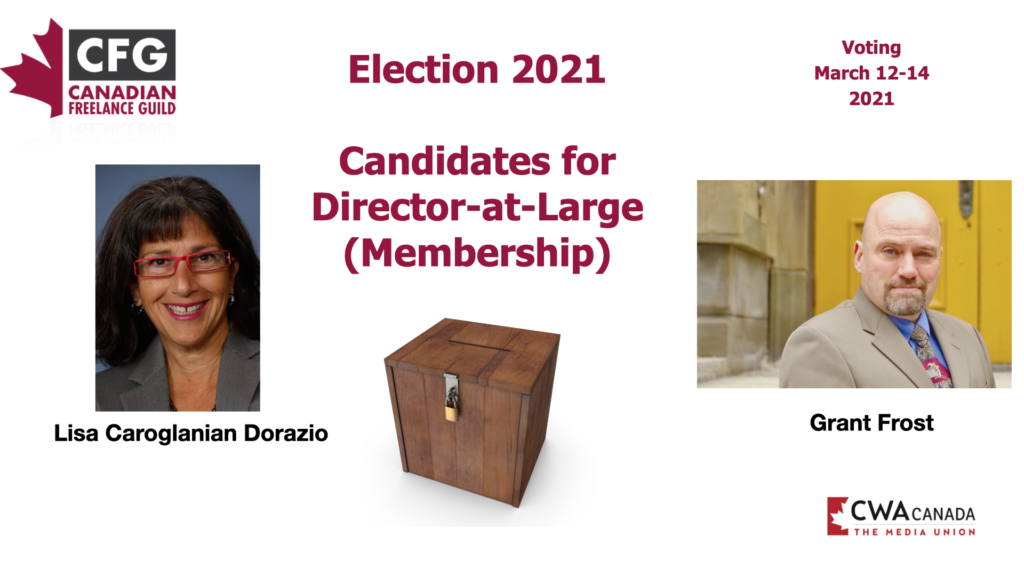
When nominations closed on the February 25th for the very first Canadian Freelance Guild Board of Directors, every position but one had been filled by acclamation. During our Media Mixer on the 26th, we had the successful candidates introduce themselves, as well as the two candidates for the remaining position, the Director for Membership…
by Steven ThrendyleMost magazine writers and newspaper journalists think about writing a book at some point in their careers. Maybe it’s a deeper dive into a story that was part of a feature package, or a biography of an important event or persona in Canadian life.Recent non-fiction books by Bruce Kirkby, Justin Ling and Bob Joseph took very…
The Canadian Freelance Guild is proud to partner with the Canadian Media Guild Freelance Branch, our colleagues in providing services to freelance communicators in Canada. CMG Freelance represents all freelancers who provide services to the Canadian Broadcasting Corporation (CBC).If you have freelanced for CBC in the last 12 months, you are…
On February 10th, about 5 dozen people took part in the CFG's Business of Freelancing Tax Tips for Freelancers webinar.This was a very lively discussion about the important questions facing freelancers at tax time -- such as eligible expenses, dealing with foreign income, the G/HST, CERB, CRB, and so on.The webinar is an excellent source of tax…
Nominations are now open for all positions on the Canadian Freelance Guild (CFG) Board of Directors.We will be electing for the positions of President, Vice-President, Secretary, Treasurer, and two Directors, one of whom will have responsibilities in Membership Management and Development. Terms will be staggered so that no board will be constituted…
On Saturday, February 6th the Canadian Freelance Guild held its first-ever Annual General Meeting. The online event took just under three hours and accomplished several important goals.Bylaws: The first-ever set of Bylaws establishing the CFG were passed, after some considerable discussion and constructive ‘friendly amendment’ editing.The new…
This series of posts by the Born Freelancer shares personal experiences and thoughts on issues relevant to freelancers. Have something to add to the conversation? We’d love to hear from you in the comments. Since the pandemic, never have the words "personal protective equipment" appeared together so ubiquitously.And it got me to thinking: …
Freelancer tax questions? Register for the next Canadian Freelance Guild (CFG) Webinar:Wednesday, February 10th  – 9 a.m. PT(10 a.m. MT/11 a.m. CT/12 a.m. ET/1 p.m. AT/1:30 p.m. NT)Marginal tax rate? Foreign income? Eligible expenses? Is COVID relief taxable? What’s different in 2020? New exemptions?Join CFG and Shannon Lee Simmons, founder…
Applications are now open for the 2021 Travers Fellowship, an international reporting bursary that helps finance foreign reporting projects by Canadian journalists working in any medium.Freelancers, students enrolled in a graduate level journalism or equivalent program, and full-time journalists are welcome to apply for the fellowship, which…

Page 17 of 159

First 15 16 17 18 19 Last